
Criminal Cases in the Monroe County Courts
Monroe County criminal cases can create two related dockets. One of the county's nine Magisterial District Courts handles the complaint, preliminary arraignment, bail, preliminary hearing, and summary matters. If charges are held for court, the prosecution moves to the 43rd Judicial District Court of Common Pleas. The District Attorney then files the formal Information, and the Common Pleas record tracks arraignment, motions, plea or trial, disposition, sentence, and later supervision events.
The Monroe County Clerk of Courts keeps the Common Pleas criminal file at 610 Monroe Street, Stroudsburg, PA 18360. The office can be reached at 570-517-3385. A district-level docket and a Common Pleas docket are not duplicates. The first tells how the charge entered court and what happened at the preliminary stage. The second shows what the District Attorney prosecuted after the case was bound over. Search both before drawing a conclusion about a Monroe County court case.
Monroe County CP and MJ Dockets
The letters at the start of a docket identify its court level. An MJ docket belongs to a Magisterial District Court. A CP criminal docket belongs to Common Pleas and may resemble CP-45-CR-0001234-2025. In that format, 45 is Monroe County's code. A charge shown on the MJ record may be withdrawn, changed, or replaced when the District Attorney files the Information.
This distinction prevents a common error. “Held for court” means the preliminary stage found enough basis for the case to continue. It does not mean the person was convicted. The current result appears on the charge and disposition lines of the later Monroe County docket. When a reader needs more detail about the larger county record system, the Monroe County criminal history overview explains how court, police, repository, and custody records differ.
The Pennsylvania minor courts resource explains the role of Magisterial District Courts. Monroe County has nine such districts feeding one Common Pleas court, so the exact office should be verified through the current court locator rather than inferred from a mailing city.
How to Search Case Records
The free Unified Judicial System of Pennsylvania Web Portal Case Search is the first online route for Monroe County criminal court cases. No account is needed for public docket sheets. A name can work, but an OTN, complaint number, incident number, or exact docket is much less likely to mix two people. Recent entries can lag, and JavaScript, cookies, popups, TLS 1.2, and a PDF reader may be needed.
- Open UJS Case Search and select the criminal court level that fits the record.
- Set the county or judicial district to Monroe or the 43rd Judicial District.
- Search with a docket, OTN, complaint or incident number when one is known. Otherwise, use the participant name and date of birth.
- Open both MJ and CP results. Read charge status, bail, events, disposition, sentence, and financial panels.
- Ask the Monroe County Clerk of Courts or the named MDJ office for certified, older, or non-imaged papers.
The official UJS search screen displays the filters used for a Monroe County docket search.
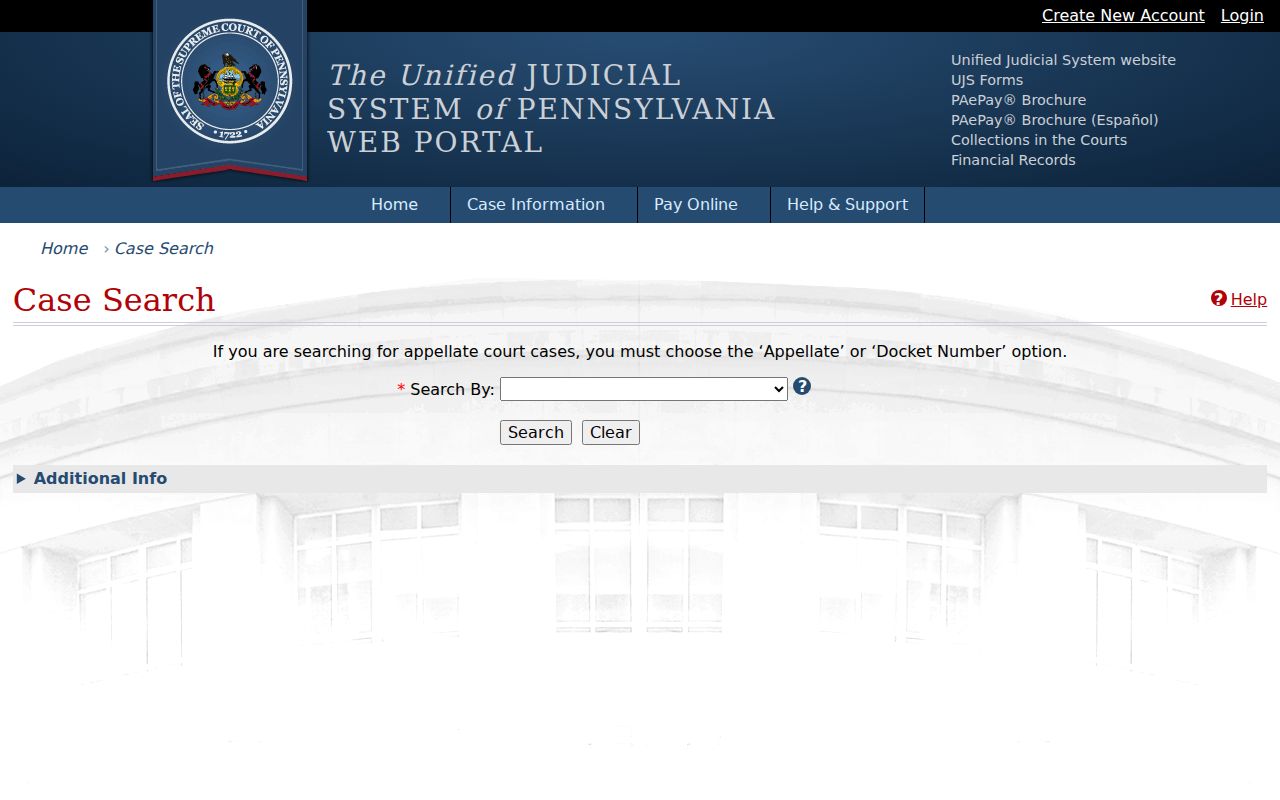
The screen supports several routes into the same public index, which is useful when a common name alone produces too many Monroe County records.
| Field Label | Type | Required | Use in Monroe County |
|---|---|---|---|
| Search By | Select | Yes | Controls the criteria displayed |
| County / Judicial District | Select | No | Choose Monroe or the 43rd Judicial District |
| OTN | Text | No | Uses the 8 to 9 character offense tracking number |
| Complaint / Incident Number | Text | No | Connects a police identifier to a court case |
| Participant Name / DOB | Text / Date | No | DOB helps narrow a common name |
| Docket Type / Status | Select | No | Separates court level and open or closed status |
| Arresting Agency / ORI | Select | No | Limits results to the agency that filed the complaint |
Monroe County Clerk Record Counter
Online docket sheets do not generally provide every filed document for download. The Monroe County Clerk of Courts page is the official fallback for Common Pleas records. The counter can help with older or non-imaged papers, certified copies, and questions about the file held by the clerk. Monroe County Court Administration is also at 610 Monroe Street and publishes weekday hours of 8:30 a.m. to 4:30 p.m.
The official Clerk page shows the contact point for Monroe County criminal case records.
The pictured county channel matters when a UJS entry lists a filing but offers no public image. Statewide judiciary forms list ordinary photocopies at $0.15 per page beginning with 11 or more pages, a CD at $5, and postage at actual cost. Current certification or search fees should be confirmed with the Clerk before ordering.
Monroe County Clerk of Courts
610 Monroe Street
Stroudsburg, PA 18360
570-517-3385
Common Pleas criminal files, copies, and certification questions.
Courthouse visitors enter through the main entrance and pass the Sheriff's screening point. Phones and laptops may enter after screening, but devices must stay silent in court and recording is barred in courtrooms, hearing rooms, proceedings, and their environs.
What the Case File Shows
A Monroe County criminal case file follows the court's work, not just the arrest. Public docket sheets identify the court, charge sequence, counsel, bail, hearings, disposition, sentence, and money due. They can also show an OTN and lower-court cross reference. Protected identifiers, confidential papers, victim details, and some personal data are removed from the public view.
| Case Number and Court | CP or MJ docket, Monroe County district, filing date, and case status |
|---|---|
| Charging Documents | Complaint at the MDJ level and the District Attorney's Information in Common Pleas |
| Charge Lines | Statute, description, grade, sequence, and a result for each count |
| Bail and Events | Bail type and status plus hearings, motions, plea, trial, and warrant entries |
| Disposition | Withdrawn, dismissed, nolle prosequi, acquitted, plea, verdict, ARD, or open status |
| Sentence and Finances | Confinement or probation terms, credit, concurrent or consecutive terms, fines, costs, restitution, and balance |
Read each count rather than relying on the caption. One charge can end while another proceeds. The arrest grade may also differ from the grade in the Information or final conviction.
Monroe County Case Status Terms
Several short labels carry very different meanings in Monroe County criminal records. The final court result is not the same as the arrest allegation. A docket may also show a diversion track rather than a conviction.
- Withdrawn
- The prosecution ended a charge, often at the preliminary stage.
- Nolle prosequi
- The prosecution ended a charge with the court's permission.
- Acquitted
- The person was found not guilty after adjudication.
- ARD
- Accelerated Rehabilitative Disposition is pretrial diversion, not a guilty verdict. Eligible completion may support expungement.
- Capias or bench warrant
- Court process that often follows a missed appearance or other noncompliance.
- Limited access
- The record remains, but ordinary public dissemination is restricted.
The Monroe County Public Defender publishes a detailed local explanation of criminal procedure. Its account helps place the Information, Common Pleas arraignment, ARD, plea, trial, sentence, and probation in the correct order.
Stages of a Criminal Case
A Monroe County case starts with the police complaint and preliminary court steps. The MDJ addresses the first appearance, bail, and preliminary hearing. A dismissal can end the matter there. When charges are held, the District Attorney files an Information in Common Pleas. The file then records arraignment, pretrial work, a plea or trial, and the result for each count.
Case flow: Charges Filed › Arraignment › Pretrial › Plea or Trial › Disposition › Sentencing
Timing varies by case. The local Public Defender says an Information is normally prepared within weeks or months after charges are held. That is not a promise for a specific Monroe County docket. Calendar entries and filed orders remain the best source for the actual case schedule.
After sentencing, the record may show confinement, probation, restitution, or later violation proceedings. A Pennsylvania minimum prison term marks parole eligibility, not guaranteed release. Concurrent terms run together, while consecutive terms run one after another.
Monroe County Criminal Case Grades
UJS charge lines use F1, F2, F3, M1, M2, M3, and S. Felony and misdemeanor cases move through Common Pleas after the MDJ stage. Summary cases are ordinarily handled at the MDJ level. The grade helps identify the court and the general statutory ceiling, but a specific offense law or repeat-offender rule can change the result.
| Grade | General Maximum | Monroe County Court Route |
|---|---|---|
| F1 | 20 years | Common Pleas |
| F2 | 10 years | Common Pleas |
| F3 | 7 years | Common Pleas |
| M1 | 5 years | Common Pleas after MDJ |
| M2 / M3 | 2 years / 1 year | Common Pleas |
| Summary | Generally 90 days | Magisterial District Court |
These general limits come from 18 Pa.C.S. §§ 1101 through 1105. They do not predict the sentence in a Monroe County case.
Monroe County Criminal Defense Records
The District Attorney and Public Defender occupy different parts of the case trail at 701 Main Street. The District Attorney's Office is in Suite 100 and can be reached at 570-517-3052. The Public Defender is in Suite 301 at 570-517-3042 and handles eligible Pennsylvania cases, not federal charges. Their work may appear in the court file through the Information, appearances, motions, plea papers, and other public docket entries.
The Monroe County Public Defender page identifies the office and its services.
The office's public procedure material is a useful reading aid, but the filed Monroe County docket and court orders control the actual case.
Access & Restrictions
Pennsylvania court case records follow the judiciary's own public-access policies, not the executive branch RTKL process. The UJS Case Records Public Access Policy governs statewide requests, confidential documents, and redaction. The Pennsylvania Right-to-Know Law still matters for executive agency records, but it does not turn a police investigative file into a court filing or override judicial rules.
Juvenile, sealed, expunged, limited-access, destroyed, and other nonpublic Monroe County cases may not appear in ordinary UJS results. Social Security numbers, financial account data, protected medical material, victim information, and confidential filings can also be hidden or redacted. A blank search is therefore not proof that no event ever occurred.
Ask the record holder about a missing public item. The Clerk handles Common Pleas files, the named MDJ keeps its lower-court paper record, the arresting agency owns its report, and Monroe County Correctional Facility holds jail intake material. The Monroe County Sheriff provides court security and holds Sheriff-created records, but it is not the clerk for every criminal case. This office-by-office route keeps the case record tied to its true custodian.